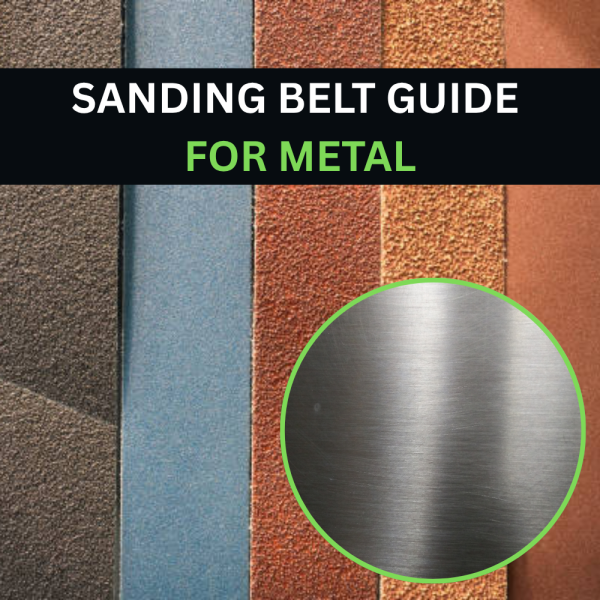
How to Choose the Right Sanding Belt for Metal
The right sanding belt for metal depends on more than grit. Mild steel, stainless steel, aluminum and high-alloy metals do not all grind the same way. A belt that works well for light deburring may glaze over during heavy weld removal, while an aggressive belt can create unnecessary heat or leave scratches that take several steps to remove.
The goal is to match the abrasive grain, grit and backing to the metal, the amount of material you need to remove and the machine you are using. Get those decisions right and you can cut more efficiently, control heat and reach the required finish with fewer corrective steps.
Already know your width, length, grit and belt material? Head directly to our Custom Sanding Belt Builder. Otherwise, this guide will help you narrow down the right combination.
Metal Sanding Belt Selection at a Glance
| Metalworking job | Good starting point | Typical grit direction |
|---|---|---|
| General sanding on mild or carbon steel | Aluminum oxide for general-purpose work; zirconia when faster, heavier removal is required | 60–120 grit for general sanding |
| Heavy stock or weld removal on steel and stainless steel | Zirconia or ceramic on a strong cloth backing | 16–60 grit |
| Stainless steel and high-alloy metals | Zirconia; ceramic for demanding, high-load production work; choose a product rated for the alloy | Start only as coarse as the removal requires, then work finer |
| Aluminum and other non-ferrous metals | A material-rated aluminum oxide or silicon carbide belt; consider a semi-open or anti-loading product when loading is a problem | Match the starting grit to the amount of removal |
| Knife making and hardened steel | Zirconia or ceramic for rough grinding; flexible, heat-managing products for contours and finer stages | Commonly spans coarse shaping through 400 grit or finer, depending on the process |
| Curves, tubes and profiles | A metal-rated abrasive on a flexible J-weight or J-flex cloth backing | Match the grit to the removal or finishing step |
| Satin finishing, blending and light deburring | Non-woven surface-conditioning belt | Select coarse, medium or fine grade for the desired finish |
| Fine finishing | Fine-grit aluminum oxide or an application-appropriate silicon carbide belt | 150 grit and finer |
These are starting points rather than fixed rules. The belt manufacturer's application data, your machine specifications and the required finish should always take priority.
Do not choose by grain name alone. Two belts using the same abrasive grain may have different backings, coating densities, grinding aids and intended materials. Always confirm that the specific belt is recommended for the metal and operation.
1. Choose the Abrasive Grain
The abrasive grain does the cutting. Each grain type behaves differently under heat, pressure and repeated contact with metal.
Aluminum Oxide: The General-Purpose Choice
Aluminum oxide is a practical, economical choice for general metal sanding. Depending on the specific product, it can be used on steel, stainless steel and non-ferrous metals for deburring, surface preparation and finishing.
It is especially useful for lower- to medium-demand work where a premium self-sharpening grain would offer little advantage. Flexible aluminum oxide belts are also common for contours, pneumatic drums and later stages of knife making.
Zirconia Alumina: For Heavy Removal
Zirconia alumina is tough and self-sharpening, making it well suited to heavy stock removal, weld grinding and demanding work on steel and stainless steel. As the grain wears under load, it fractures and exposes fresh cutting edges.
Zirconia is most useful when the machine and application can keep the grain cutting. For light finishing or low-pressure work, a general-purpose aluminum oxide belt may be the more practical choice.
Ceramic Alumina: For Demanding Metalwork
Ceramic alumina is a high-performance, self-sharpening abrasive used for demanding work on stainless steel, tool steel, titanium and other hard alloys. It is a strong option for production grinding, weld removal and edge work where the machine can provide the appropriate speed and load.
Ceramic is not automatically the best belt for every metalworking job. Its higher cost is easier to justify in demanding applications that can take advantage of its cutting rate and durability. For light deburring or finish work, another grain may be a better fit.
Silicon Carbide: For Fine and Specialty Applications
Silicon carbide is very hard and sharp but more brittle than aluminum oxide. Depending on the product, it is used for fine finishing on metal and for selected non-ferrous applications, including brass and other contoured parts.
Because suitability varies by product, check the manufacturer's application list rather than assuming every silicon carbide belt is suitable for every metal.
Surface-Conditioning Belts: For Blending and Satin Finishes
Non-woven surface-conditioning belts use abrasive grain in a conformable web. They are useful for blending, light deburring, removing discolouration, roughening a surface and producing a more uniform satin finish without the aggressive cut of a conventional coated abrasive.
They are not a substitute for a coarse belt when substantial stock or a heavy weld must be removed. Complete the cutting work first, then use the surface-conditioning belt for the finishing step.
Some metalworking belts also include a grinding aid or multibond coating to help reduce heat during grinding. These treatments can be particularly useful on stainless steel and heat-sensitive alloys, but they are product-specific.
2. Select the Right Grit
Lower grit numbers use larger abrasive particles for faster material removal. Higher numbers use smaller particles that leave a finer scratch pattern.
| Grit range | Common metalworking use | What to expect |
|---|---|---|
| 16–36 | Severe stock removal, heavy weld grinding and major surface correction | Very aggressive cutting with deep scratches |
| 40–60 | Weld blending, deburring, shaping and general stock removal | Fast cutting that normally requires further refinement |
| 80–120 | Smoothing, removing coarser scratches and preparing for finishing | Moderate removal with a more controlled scratch pattern |
| 150–240 | Surface refinement, pre-polish work and preparation for some coatings | Finer scratches and lower removal per pass |
| 320–800 | Fine or specialty finishing with a belt designed for the material | A refined finish with limited stock removal |
The correct starting grit depends on the condition of the workpiece. A prominent weld or damaged edge may require a coarse belt, while a clean part that only needs coating preparation can often begin much finer. Starting coarser than necessary creates deeper scratches and adds work to every step that follows.
Use a Sensible Grit Progression
Each grit should remove the scratches left by the previous one. Jumping directly from a coarse belt to a fine belt slows the process and can leave isolated deep scratches in an otherwise refined surface.
A practical progression after coarse grinding might be:
40 → 60 → 80 → 120
Continue to 180, 240 or finer only when the required finish calls for it. The best sequence depends on the metal, the belt product and whether the part will be painted, plated, polished or left with a directional finish. Inspect under consistent lighting between steps so the previous scratch pattern is removed before moving finer.
Surface-conditioning belts are normally identified by grades such as coarse, medium and fine rather than the same numbered grit sequence used for coated abrasive belts. Choose the grade by the finish required, not by trying to make an exact grit-for-grade substitution.
3. Match the Backing to the Surface and Machine
The backing supports the abrasive grain. It affects the belt's strength, flexibility, tracking and ability to hold a flat surface.
| Backing | Best suited for | What to know |
|---|---|---|
| J-weight or J-flex cloth | Curves, tubes, profiles, pneumatic drums and knife-making contours | Flexible enough to follow the workpiece, but not intended for the heaviest pressure |
| X-weight cloth | Portable belt sanders, bench machines and general metalworking | A practical balance of strength and flexibility |
| Y-weight polyester cloth | Heavy stock removal, weld grinding and demanding stationary equipment | Strong and tear-resistant, but less conformable |
| Non-woven web | Blending, satin finishing, light deburring and discolouration removal | Conformable and finish-focused, with lower stock removal than a coated abrasive |
Most general metalworking belts use a cloth backing because it tolerates edge work, tension and demanding use. Paper-backed metal belts are specialized products rather than the usual starting point for handheld, bench or knife-making applications.
The backing is often determined by the abrasive product and available belt size rather than selected independently. If your application requires a specific backing, grinding aid, coating or belt joint, contact us before ordering.
4. Confirm the Belt Size and Machine Requirements
Even the correct abrasive and grit will perform poorly if the belt does not fit, track or run correctly.
Confirm the required width and length in the machine manual or on the existing belt. If the markings are unreadable, cut an old belt at the joint, lay it flat and measure the full length. You can also wrap non-stretch string or masking tape around the machine's belt path, mark the overlap and measure it flat.
Keep the tensioning system within its usable adjustment range when measuring. A belt at the machine's absolute maximum path length may not leave enough travel to apply proper tension.
Before installation:
Confirm the exact width and length
Check whether the belt has a directional arrow
Inspect the platen, contact wheel, rollers and tracking system
Use the tension recommended by the machine manufacturer
Confirm that the belt is intended for the metal, operation and machine speed
Make sure guards, ventilation or extraction and required personal protective equipment are in place
Never run a damaged belt or force a belt that is too short, too long or too wide for the machine. Use a wet process only when both the belt and machine are designed for it.
A Note About Metal Dust and Sparks
Metal sanding can create flying particles, sparks and airborne dust. Keep sparks away from flammable material, use suitable ventilation or extraction and follow the machine instructions, workplace procedures and safety data for the metal being sanded.
Some finely divided metal dusts, including aluminum, can be combustible. Do not blow accumulated dust into the air with compressed air or collect it with equipment that is not approved for the hazard. A metal-dust collection system must be designed for the material and process; an ordinary shop vacuum is not automatically suitable.
5. Prevent Loading, Overheating and Uneven Finishes
| Problem | Likely causes | What to check |
|---|---|---|
| Belt loads or smears | The belt is not suited to the metal, soft non-ferrous material is filling the coating, or extraction is inadequate | Use a product rated for the material; consider a semi-open or anti-loading belt where appropriate |
| Belt glazes and stops cutting | The belt is worn, the grit is too fine for the removal, or the application is not putting a self-sharpening grain to work | Replace the belt or select an abrasive and grit better matched to the machine and operation instead of simply pressing harder |
| Metal discolours or overheats | A dull or loaded belt, excessive pressure or dwell time, or an unsuitable belt | Use a sharp belt, keep the work moving and consider a material-rated cool-grinding product |
| Deep scratches remain | Starting too coarse, skipping grit steps, debris on the workpiece or an incomplete previous step | Clean and inspect between grits; remove the full scratch pattern before moving finer |
| Edges round over or geometry changes | A backing that is too flexible, uneven pressure or poor support | Use a more stable backing or platen and make controlled, consistent passes |
| Belt tracks poorly or the edge frays | Incorrect size, direction or tension; worn rollers; tracking misalignment or side loading | Stop the machine and correct the cause before the belt edge or joint is damaged |
Do not compensate for a dull belt by exceeding the machine's recommended pressure or operating limits. A fresh belt that is suited to the material usually cuts more predictably and produces less unwanted heat.
Ready to Order Your Metalworking Sanding Belts?
Once you know the width, length, grit and abrasive material, enter your specifications in our online builder to see the available options, pricing and order minimum.
Skookum sanding belts are made to order and converted in Canada using premium abrasive materials. Standard and hard-to-find sizes can be configured for fabrication shops, knife makers, production equipment and everyday belt sanders.
Build Your Custom Sanding Belts
Still unsure? Give us a call 250-590-2178 (for toll free 1-888-665-6936), or shoot us an email at [email protected].